Showing posts with label censorship. Show all posts

Friday, September 25, 2015

More on Trump's "authenticity"

Frank Rich is a good columnist who over the weekend engaged in a bit of silly contrarianism entitled "Donald Trump is saving our democracy." And no, he wasn't being sarcastic.
...for all the efforts to dismiss Trump as an entertainer, in truth it’s his opponents who are more likely to be playacting, reciting their politically correct and cautious lines by rote. The political market for improvisational candor is as large as it was after Vietnam and Watergate, and right now Trump pretty much has a monopoly on it.
Steve M. of Crooks and Liars wrote in response:
Candor? You can use a lot of words to characterize Trump's rhetoric in this campaign, but the one thing he's not giving us is candor -- certainly not about himself, and certainly not about the vast majority of the issues.... We know he's lying when he says he has a "foolproof plan" to beat ISIS. We know he's lying when he says he'll get Mexico to pay for a border fence. We know he's lying about his own net worth. We know he lied in the last debate about his efforts to establish casinos in Florida.
In my last post I marveled at how quick so many people are to attribute honesty to Trump, but it's especially striking coming from a liberal like Rich. It shows how deeply ingrained this way of thinking is in our culture--this habit of equating sincerity with a willingness to outrage. Commentators like Rich overlook the fact that some celebrities seem to have a pathological need to put themselves in the headlines, and that they achieve that goal by deliberately stoking outrage. It's a tactic that usually works very well, because outrage is to the media what a flame is to moths.

Why do so many people mistake this tactic for honesty? I think it comes from a sense most people have that if they were placed in front of a TV camera and were to speak aloud every thought that passed through their mind, they'd start offending people before long. I'm reminded of a bit from a Steven Wright routine:

"Do you swear to tell the whole truth and nothing but the truth, so help you God?" Yes, you're ugly. See that woman in the jury? I'd really like to sleep with her.
One thing most people figure out sometime after their 6th birthday is that an essential part of functioning in the world is avoiding saying what you really think about other people. You learn not to tell someone you find them annoying and would like them to leave; you learn not to tell someone your assessment of their sexual attractiveness or how that colors your perception of them; you learn not to say you feel immediate anxiety at the sight of a young black man walking down the street; you learn not to say transgender people make you uncomfortable.

Since many people avoid saying these sorts of things out of fear of shame, embarrassment, and ostracization, they automatically assume that the only possible explanation for why someone might break these taboos is honesty and courage. They fail to understand the topsy-turvy world celebrities live in, where it can be remarkably easy to lose one's sense of shame when doing so can be the source of a lucrative career. And it's especially seductive to think of such celebrities as bold truth-tellers if the things they're saying happen to agree with your own private beliefs.

For the record, I do think there are aspects of our culture that have gone too far in trying to suppress feelings of prejudice on such matters as race, religion, and gender. We've made bigotry into such a supreme evil that many ordinary, well-meaning people feel they have to pretend no such feelings exist inside of them when it would probably be healthier if they got it out into the open. You can call this problem "political correctness" if you like. But confronting these feelings is only a good thing if your ultimate purpose is to grow past them. Most attacks on PC, including Trump's, are based on the idea that these feelings should be expressed because they reflect sound judgment and an accurate perception of the world--and, further, that we know that's true simply because they've been suppressed. Their taboo status is their justification.

The attack on "political correctness" began in the 1980s as a critique--and a largely legitimate one, in my view--of the stifling atmosphere on many college campuses in America. But it has since devolved into a rallying cry in defense of ignorant and reactionary beliefs. When someone says "I'm not politically correct," what they usually mean is that they're refusing to rethink their beliefs in the face of other people's negative reactions to them. It's a way of celebrating a primal and simplistic outlook and treating any challenges to it as censorship.

What PC originally referred to has hardly any relevance to a figure like Trump. His views aren't being shut down, and he isn't going to starve for having expressed them. And however entertaining his candidacy may be, I can't bring myself to call his taboo-breaking courageous, not when he's getting exactly the kinds of results he craves: he's the center of attention, he's riding high in the polls, he's generating all the headlines. It should be patently obvious that he's saying what he says because he knows what buttons to push. Bashing immigrants in a Republican primary doesn't take courage; defending immigrants would. Now that would be a true example of "political incorrectness"--except nobody uses the term that way. Instead, we use it only to describe the outrageous and offensive, and to wallow in the delusion that it automatically shows authenticity and courage.

Thursday, July 07, 2011

Anti-smurfite

Last month HuffPost ran an article about a newly published book by a French author which argues that the original Smurf cartoons were works of racist, anti-Semitic, and socialist propaganda. A few weeks later, an article in The Forward elaborated on this theory without mentioning either the HuffPost article or the French book. According to this theory, Gargamel looks like an anti-Semitic caricature of a Jew, down to his hooked nose, and this suspicion is heightened by the fact that the goal of his nefarious plans is money. As the Forward article puts it, "All that Gargamel lacks is a yarmulke."

This theory isn't new. Back in 2007, JewOrNotJew.com did a half-joking piece on the matter, concluding that "someone out there is really bigoted--the creator of the cartoon or the creator of the theory. Probably a little of both really." I myself never noticed any of this as a kid, apart from wondering why Gargamel's cat, Azrael, had a Hebrew name.

I believe it is within the realm of possibility that the Smurfs' creator Peyo could have been an anti-Semite. But I'm hesitant to endorse this theory, not because it will spoil my childhood, but because it's all speculative. I know nothing about Peyo's life, and he isn't around to defend himself against these charges. (A son of his, however, has dismissed the accusations as "between the grotesque and the not serious.") None of the articles I've seen have provided any new information, just interpretations of what I already know.

Actually, let me qualify that a little. The HuffPost article did mention one fact that I admit was pretty damning with regard to another prejudice. Apparently the very first Smurf cartoon was called "The Black Smurf" and was about a disease that turns smurfs black, where they become dimwitted and say "nyap nyap." US publishers refused to print this cartoon, and later they made the infected smurfs purple. (I remember reading a strip concerning a green smurf that bites other smurfs to turn them green--but my memory could be failing me as to the exact color. I just assumed it was the smurf equivalent of vampires or zombies.) That does sound racist, and quite similar to things on our side of the pond from Disney and Warner Bros. (many of which, such as the black centaurs in Fantasia, have been censored).

As for Gargamel's alleged Jewishness, I have much the same reaction as JewOrNotJew.com: it makes me uncomfortable, but there's no conclusive evidence to prove this theory correct. Gargamel is never identified as a Jew. He doesn't have a Jewish-sounding name or speak any Yiddish. The evidence, such as it is, apparently escaped the notice of American producers of the Saturday morning cartoons (which I watched as a kid through a VCR, an invention of great use to observant Jews in the '80s). It's also possible that the element of anti-Semitic stereotyping was subconscious, rather than part of an agenda, on Peyo's part.

I'm reminded of when The Phantom Menace came out and some critics suggested that some of the alien creatures were thinly disguised racial and ethnic stereotypes. What provoked the most ire were the inaptly (or ineptly) named Gungans, especially Jar Jar, a flop-eared, blubbering creature whom Newsweek's David Ansen described as "a kind of intergalactic Stepin Fetchit." Getting only slightly less attention were the "Asian" Neimodians and the slaveowner Watto, a winged creature with a hooked beak, a strange accent, and more than a dollop of greed. Slate's Bruce Gottleib reacted indignantly to Richard Corliss's suggestion that Watto's accent was "Turkish":
Turkish? Even without the visual clue of the hooked nose, Watto's accent is clearly Yiddish, not Turkish. Or click "No"; listen again; and you tell me: Is Corliss crazy or am I?
Personally I don't think either writer is crazy, but I didn't pick up what Gottlieb was hearing in Watto's voice, even after downloading that sound clip. I'm no expert on Turkish accents, but Watto's accent did not strike me as Yiddish. And I should know, given that my maternal grandfather had one.

Part of the problem is that Lucas made a choice in the prequels to have some of his aliens speak English in made-up accents, rather than totally made-up languages like in the original trilogy. This wasn't a bad idea in the abstract. In an intergalactic society, I imagine there would be diverse accents and not just diverse languages. But I think that whenever people hear an accent they can't immediately identify, their instinct is to compare it to accents they know. JewOrNotJew.com dismisses the theory about Watto before you can say "smurfin' awesome":
If a character is designated as Jewish and is portrayed as loving money, having a big nose, being henpecked by women, whatever, that's a negative Jewish stereotype and the creator should be called to task.

But if a character has a big nose and loves money and the anti-defamation league or whoever says that makes him/her Jewish, well, that's not the creator of the character spreading negative stereotypes. That's the Jews themselves.
But then why did this same site suggest that Gargamel is "probably" the creation of a bigot? He has a big nose and loves money and is no more identified as a Jew than Watto is. Is it because Gargamel is a human on Earth while Watto is an alien in a galaxy far, far away? Or is it because whoever runs this site has a harder time ascribing anti-Semitic motives to George Lucas than to a mid-20th-century Belgian whose life story isn't well-known?

That's part of the way I look at it, I admit. I highly doubt Lucas is consciously racist or anti-Semitic. I think it's possible the echo of ethnic stereotypes could find its way into Star Wars, a potpourri of myths, legends, and old movies. There are elements of it in the original trilogy, though mostly too vague to seem offensive: Yoda seems modeled on an Asian master, the ewoks are rather like a stereotypical African or Amazonian tribe, and the Tusken Raiders bear a clear imprint of desert nomads on earth such as Bedouins. I'm sure Lucas would be the first to admit all this. But he has consistently gotten defensive at any suggestion of racial insensitivity on his part. He did so when the 1977 film came out and some critics complained about the all-white cast (except for James Earl Jones as the voice of Vader). He did so when critics of The Phantom Menace complained about Jar Jar and co.

While I'm not ready to let Lucas totally off the hook about Jar Jar, I never noticed the stuff about Watto until others pointed it out. And I ought to have enough Jewdar to pick it up, if it was there. I don't hope to convince anyone who did see it, however. There's a heavy amount of subjectivity in these interpretations, and yet you can't totally dismiss the idea of veiled racism in a children's fantasy, because it's a fact that there's a long tradition of it. All I can do is try to distinguish those who have ill intent from those who stumble into these images by accident.

Friday, September 25, 2009

The twin straw men

Jimmy Carter has helped highlight some intriguing parallels between Israel-bashing and Obama-bashing. He stated recently that "an overwhelming portion of the intensely demonstrated animosity" toward President Obama is fueled by racism. Israel supporters have long made a similar argument about anti-Semitism in the type of Israel-bashing that, ironically, Carter has engaged in. For their part, Israel-bashers and Obama-bashers both like to invoke the straw-man argument that the bigotry charge is being used against all criticism of the subject in question.

Israel-bashing

Soon after the release of his book Palestine: Peace, Not Apartheid, Carter asserted, "There is no debate in America about anything that would be critical of Israel." Of course that statement is demonstrably false, as a glance at the editorial page of any standard newspaper will reveal. Indeed, Carter's own critical pieces on Israel have been carried by major papers both before and after the publication of his controversial book.

That's where the straw man comes in: following some inflammatory, over-the-top attack on Israel, the bashers insist they're being vilified simply because they had the temerity to "criticize" the Israeli government, as if calling Israel an apartheid state falls in the same category as complaining about its bus routes.

It would be one thing if these commentators argued simply that there isn't enough debate about Israel, and that certain criticisms are unfairly labeled as anti-Semitic. Instead, they make the extraordinary claim that all criticism of Israel is treated this way. This claim has been repeated so many times it has become a sort of mantra in anti-Israel circles, despite the fact that it crumbles under the slightest scrutiny.

What's striking is that virtually no one fits this description. Every U.S. president in the last four decades has attacked the building of Israeli settlements in the territories--the mainstream position in American discourse. Even the most fervent right-wing Zionists criticize Israel all the time, as their bitter reaction to the 2005 pullout from Gaza amply demonstrated. While there is basis for saying that many on the right are too quick to apply the "anti-Semite" label to people who deviate from the Likud party line, the mainstream in this country doesn't act that way, and even the rightists aren't vilifying all "criticism" of the Jewish state.

Most Israel supporters agree that there are certain types of assertions that cross the line from legitimate criticism to veiled anti-Semitism. Where that line falls exactly is a matter of debate. Irwin Cotler, commenting on the 2001 Durban conference, gives several examples of such assertions. These include calling for the destruction of Israel, attacking the legitimacy of the Jewish state, depicting Israel as the prime source of the world's evils, comparing the Israeli government with the Nazis, and singling out Israel for condemnation while ignoring or downplaying comparable or worse happenings in other countries. As Cotler observes,
For example - and apart from Durban - in December 2001, the contracting parties of the Geneva Convention convened for the first time to criticize Israel. This was the only time in 52 years that any nation was indicted. Similarly the UN Commission on Human Rights has singled out Israel for discriminatory indictment while granting the real human rights violators exculpatory immunity.

None of this is intended to suggest that Israel is above the law or is not accountable for any violations of international human rights and humanitarian law like any other state. Quite the contrary. But the problem is not that anyone should seek that Israel be above the law, but that Israel is being systematically denied equality before the law.
Convincing the average American that these sorts of criticisms are not merely unfair, but indicative of anti-Semitism, is tricky. It requires some knowledge of history and an understanding that the Israeli-Palestinian crisis has often been framed in a way that encourages Israel's perceived shortcomings to receive attention far out of proportion to their importance in world affairs. Adding to the problem is that Israel, since its inception, has been surrounded by enemy countries whose leaders have often expressed explicitly genocidal wishes against the Jews. The destruction of Israel isn't just a political goal, but a call to mass murder.

What's notable about Israel-bashing is that, unlike ordinary criticisms of a country's sins, it is usually directed, subtly or overtly, at Israel's legitimacy as a country. And since Israel was created as the world's only Jewish state, it is hard not to notice traditional anti-Jewish themes cropping up under the guise of "criticizing" Israel. Carter himself unwittingly proved this point when he claimed that "most of the condemnations of my book came from Jewish-American organizations." Which organizations he had in mind, he did not say. As Deborah Lipstadt noted, most of the strongest public condemnations of his book came from Michael Kinsley, Ethan Bronner, Jeffrey Goldberg, Alan Dershowitz, Dennis Ross, and 14 members of the Carter Center's Board of Councilors who resigned in protest. All are Jewish, but none represent a Jewish organization.

Obama-bashing

Bill O'Reilly recently lambasted two columns, one by Eugene Robinson and the other by Maureen Dowd, who believe, according to O'Reilly, that "if you criticize somebody [they like] and it's a person of color, then immediately you're a racist." In fact, neither column suggested anything of the kind.

They were both reactions to Joe Wilson (R-SC), who shouted "You lie!" during the President's health care address. Robinson's column discussed at length the open disrespect shown toward the President by Wilson and other Republican Congressmen at the speech before adding, "I suspect that Obama's race leads some of his critics to feel they have permission to deny him the legitimacy, stature and common courtesy that are any president's due. I can't prove this, however." Dowd argued that Wilson's former membership in a neo-Confederate group, his campaign to keep the Confederate Flag flying above the state Capitol, and his dismissing as a "smear" a black woman's truthful claim to be Strom Thurmond's illegitimate daughter, formed an ominous pattern that cast suspicion on his unprecedented departure from accepted standards of decorum in front of the nation's first black president.

That's where the straw man comes in: following some inflammatory, over-the-top attack on Obama, the bashers insist they're being vilified simply because they had the temerity to "criticize" the President, as if shouting him down as a liar while he's speaking falls in the same category as complaining about his tariff policy.

It would be one thing if these right-wingers argued simply that there isn't enough criticism of the President, and that certain criticisms are unfairly labeled as racist. Instead, they make the extraordinary claim that all criticism of Obama is treated this way. This claim has been repeated so many times it has become a sort of mantra in anti-Obama circles, despite the fact that it crumbles under the slightest scrutiny.

What's striking is that virtually no one fits this description. Robinson, Dowd, and even Carter have all criticized Obama before. But you wouldn't know that from reading most of the right-wing sites, which, like O'Reilly, claim that these commentators apply the "racist" label to all who dare say anything negative about The One. A more recent Robinson column explains clearly when he feels attacks on Obama cross the line from legitimate criticism to veiled racism:
Of course it's possible to reject Obama's policies and philosophy without being racist. But there's a particularly nasty edge to the most vitriolic attacks -- a rejection not of Obama's programs but of his legitimacy as president. This denial of legitimacy is more pernicious than the abuse heaped upon George W. Bush by his critics (including me), and I can't find any explanation for it other than race.

I'm not talking about the majority of the citizens who went to town hall meetings to criticize Obama's plans for health-care reform or the majority of the "tea bag" demonstrators who complain that Obama is ushering in an era of big government. Those are, of course, legitimate points of view. Protest is part of our system. It's as American as apple pie.

I'm talking about the crazy "birthers." I'm talking about the nitwits who arrive at protest rallies bearing racially offensive caricatures -- Obama as a witch doctor, for example. I'm talking about the idiots who toss around words like "socialism" to make Obama seem alien and even dangerous -- who deny the fact that he, too, is as American as apple pie.
Of course one may legitimately disagree with Robinson. Obama is hardly the first president to be the subject of vitriolic attacks and kooky conspiracy theories. Robinson's point of contrast is with Bush, but I was thinking about Clinton, whose detractors called him a murderer, a rapist, and a drug addict and likened him to both Hitler and Stalin. On the other hand, no one threatened secession, or said he had a "deep-seated hatred of white people," or accused him of having been born outside the United States. Some of the attacks on Obama seem clearly to have racial (or xenophobic) overtones, but there are those on the left who see a racial motivation in less obvious examples such as Joe Wilson's outburst, which didn't happen when Clinton was in office but conceivably might have. Irrational hostility toward Obama may be rooted in racism, but it also may be rooted in the way Republicans tend to behave while out of power.

Conclusion: the parallels

Israel supporters and Obama supporters both believe that a significant amount of the hostility they receive is motivated by bigotry. Israel-bashers and Obama-bashers react by claiming that supporters are using the bigotry charge to silence all criticisms. This claim has become a sort of mantra among the bashers even though it falls apart under the least bit of scrutiny. In reality, even the staunchest Israel supporters criticize Israel, and even the staunchest Obama supporters criticize Obama. There is, however, basis for arguing that Israel supporters and Obama supporters sometimes try to suppress some criticisms by unfairly branding them as bigoted.

Nevertheless, what Israel supporters and Obama supporters are mainly reacting to are the more extreme, inflammatory attacks, particularly those that seek to undermine the legitimacy of Israel as a country, or the legitimacy of Obama as a president. Whether those sorts of attacks are in fact evidence of bigotry can be debated, and depends to some extent on one's understanding of the history of racism in the U.S. or of anti-Semitism in the world at large. But those who do see bigotry in these attacks should at least have their views described accurately rather than caricatured to make them easier to knock down.

(Hat tip to Rabbi Harry Maryles for the cartoon.)

Friday, March 28, 2008

Limited interpretations

I occasionally listen to a college radio station in my area. Whenever I turn to it, I expect to hear songs I've never heard before. It plays music from different genres and eras, with an emphasis on indie or obscure or up-and-coming artists--things that fall below the radar of the mainstream.

One day, I heard on this station an odd song with striking, evocative lyrics that I assumed were directed at President Bush. The genre was hard to place: it sounded like folk, but had a certain jazzy quality. Featuring a synth riff and a sort of pop-gospel chorus, it was sung by a man with a very low, raspy voice that might have become annoying if not for the infectiously catchy melody and complex chord arrangement.

I learned that the song was Leonard Cohen's "Everybody Knows," and that it was recorded in 1988, kind of early to be talking about Dubya. What made me think it was an anti-Bush anthem? Well, read the first two verses:
Everybody knows that the dice are loaded
Everybody rolls with their fingers crossed
Everybody knows the war is over
Everybody knows the good guys lost
Everybody knows the fight was fixed
The poor stay poor, the rich get rich
That's how it goes
Everybody knows

Everybody knows that the boat is leaking
Everybody knows the captain lied
Everybody got this broken feeling
Like their father or their dog just died
Everybody talking to their pockets
Everybody wants a box of chocolates
And a long stem rose
Everybody knows
If this song were part of the current Bush-bashing bandwagon, it would probably be the best thing along those lines ever written. Most such music today just sounds cranky and self-righteous. (Green Day is the worst offender in that area.) This is surprising when you consider the many great protest songs from the Vietnam era. Those were better in part because their grievances had less to do with a specific U.S. president, in part because the threat of censorship encouraged more subtlety.

I'm not the only person to have interpreted Cohen's song this way. The only Youtube video currently playing the studio version consists of slides attacking the Bush Administration. Whether Cohen would approve of his song being used for that purpose, I have no idea.

If the song isn't about Bush, what is it about? Commenters on Youtube said it was about the AIDS virus. While I do agree that the song alludes to AIDS (especially in the fifth verse), I don't think that's the whole picture. The pivotal line "Everybody knows the war is over / Everybody knows the good guys lost" would seem to encompass more than the battle against a disease. At least I like to think so. Listen for yourself if you want. (It is five-and-a-half minutes long.)


A popular cover version by alternative rock band Concrete Blonde, done for the 1990 movie Pump Up the Volume (which I have not seen), provides a somewhat different take on the music and lyrics. I go back and forth on whether I prefer this version. On the one hand, the female lead, Johnette Napolitano, is a far more polished and expressive singer than Cohen (who sounds like he has laryngitis, and not in a charming Louis Armstrong sort of way). On the other hand, the cover omits two of the six verses and rearranges the remaining ones so that it ends with the one about infidelity, which almost makes the song sound like a failed-relationship ballad. (Here is the official video, which is four-and-a-half minutes long.)


I don't think the song can be reduced to one topic. It's more of a general meditation on the endless cycle of suffering and betrayal in the world. (I suspect it was partly inspired by the old black spiritual "Nobody Knows the Trouble I've Seen.") In limiting its scope to war or infidelity or AIDS, listeners overlook the poetry. They ought to sit back and lose themselves in the words and imagery before intellectualizing the experience.

Saturday, January 05, 2008

The ubiquitous PG-13 rating

Recently, I watched The Golden Compass and later discovered it was rated PG-13. This surprised me, not just because it's a children's movie, but also because it had very little violence in it and no other objectionable content. I had to wrack my brains to figure out how it had gotten so high a rating, and finally I remembered a scene in which a CGI bear rips the jaw off another CGI bear--though it happens so quickly I bet many people won't understand what they just saw. The film is considerably less violent than any of the first three Harry Potter movies, all of which received PG ratings.

Last week, I saw Live Free or Die Hard on DVD, and I had a choice whether to watch the theatrical PG-13 version, or an unrated version with extra content. I opted for the PG-13 version due to my superstitious belief that anything not shown in the theater isn't part of the "real" movie.

Still, just hearing it had a PG-13 was a red flag for me, since the other Die Hard films all have R ratings. Not surprisingly, this is the first Die Hard movie I haven't liked at all. While the film had several other problems, I suspect it's hard to make a good film with the MPAA breathing down your back.

Evidently, they made the film with R level of content, then shaved off just enough material to get a PG-13. These sorts of deals between the studio and the MPAA are basically acts of bargaining rather than the application of consistent standards. The final version is as violent as many R-rated films I have seen, with several moments in which characters get shot and blood spurts from their wounds.

We've reached an absurd situation when The Golden Compass has the same rating as Live Free or Die Hard. Somewhere along the line, after theaters began tightening their standards, studios decided that PG-13 was the most bankable rating, and pretty soon all sorts of movies were being shoved into it, artistic integrity be damned.

I have a couple of suggestions. First, stop allowing filmmakers to bargain down the ratings they receive. Second, get rid of ratings that make no difference to theaters. As far as theaters are concerned, only three categories really matter: movies that anyone may be admitted to see, movies that people under 17 may be admitted to see with a guardian, and movies that people under 17 may not be admitted to see. The G, PG, and PG-13 all fall in the first category. Their only purpose is informative, but that role has practically been rendered obsolete by sites like Screen It!, which provides parents with detailed information about the content in every film. If the MPAA wants the standards enforced, maybe they should leave the job of guidance and recommendation to other sources, which tend to be far better at it, anyway.

Wednesday, August 01, 2007

The cage of language

One of the labels I frequently attach to my posts is "power of words." I believe that words do have power. Our whole life, after all, is shaped by language. Few if any of us remember before we learned to speak, and we probably cannot even conceive of the experience. If language is a vessel for thoughts, it is one that transforms what is inside of it.

One person who truly understood this point was George Orwell, who explained his views most forcefully in "Politics and the English Language." Many people have read this wonderful essay, and many more are at least passingly familiar with Orwell's ideas. But not everyone fully grasps what he was talking about. Ironically, people today who throw around the word Orwellian are usually falling into the very trap Orwell warned against: the use of hackneyed but politically charged terms to mask lazy thinking.

Bemoaning the decline of the English language, the beginning of Orwell's essay almost sounds like it's going to be a tired old trope about the misuse of grammar. But those who read further will discover a far more distinctive argument. Indeed, one of the examples that Orwell cites of bad writing is itself a critique of grammar-related sins, an issue to which Orwell seems indifferent. The writing issues that concern Orwell are wordiness, triteness, and vagueness.

I have observed that people have three levels for understanding Orwell's critique. Level One readers interpret it simply as a call to communicate more effectively. Strunk & White's popular style manual, for example, eagerly seizes upon Orwell's humorous "translation" of Ecclesiastes 9:11 into dry academic prose: "Objective considerations of contemporary phenomena compel the conclusion that success or failure in competitive activities exhibits no tendency to be commensurate with innate capacity, but that a considerable element of the unpredictable must invariably be taken into account."

Level Two readers understand that the bad communication cited by Orwell serves a definite purpose, as the people in power try to confuse the masses. This is the most popular conception of Orwell's ideas, the kind that shows up whenever someone rallies against "doublespeak," a term that Orwell did not actually invent.

Level Three readers correctly identify the core of Orwell's message: if we don't exercise control over the language, then the language will exercise control over us. Bad communication is not merely a conscious process designed to keep the masses in line. It is something that we blind ourselves with.

What would Orwell say about the current political climate if he were alive today? Conservatives speculate that he would attack political correctness. There is definitely an element of doublespeak in PC terminology, not just because of oversensitivity but also because of the way it implicitly excludes some views from discussion.

But what many conservatives fail to acknowledge is that overuse of the phrase politically correct has itself become an Orwellian tactic. In the culture at large, the phrase has practically lost its political implications. It is simply a synonym for "polite," but with negative connotations.

I once was reading a blog discussion where a guy referred to the author of some book as an idiot. Another guy said he agreed with the criticism but added that there was no need to launch ad hominem attacks against the author. The first guy came back and retorted, "Oh, don't be so PC." This discussion, I should note, had nothing to do with politics.

What PC means, to most people, is "avoiding saying what you mean for fear of offending someone." People use the expression so that they don't have to take responsibility for their words. It gives people the license to be as offensive as they want and then make it sound as if anyone who disagrees is being namby-pamby. The elder Bush once described political correctness as something that began as "a crusade for civility" and turned into "Orwellian...crusades that demand correct behavior." I would describe the backlash against political correctness as something that began as a crusade against censorship and turned into an all-purpose excuse for poor decorum.

Orwell did not direct his criticisms against any one party or philosophy. He realized that the problem was almost universal: "Political language--and with variations this is true of all political parties, from Conservatives to Anarchists--is designed to make lies sound truthful and murder respectable, and to give an appearance of solidity to pure wind." Properly, Orwell's critique should be used for reflection, not just condemnation. We need to consider how we communicate, not just how others do. No one escapes the cage of language; the best we can do is be conscious of how it surrounds us.

Monday, May 21, 2007

Curses

Even though profanity is commonplace in the movies, I've never quite gotten the hang of hearing it in music. Though I rarely swear myself, I'm not intrinsically opposed to hearing others do it. After all, one of my favorite movies is Pulp Fiction, and one of my favorite comedians is Chris Rock. But whenever I hear it in songs, it almost invariably seems coarse to me. Why the double standard?

It may have something to do with my age and generation. Much of the music I heard growing up came through the radio and MTV, both of which censor offensive language. Movies, on the other hand, I was most likely to see through theaters, video, and premium cable stations, none of which are known to edit for content. In any case, before the 1990s swearing was not remotely as commonplace in popular music as it was in movies. When Ozzy Osbourne reinvented himself as a reality TV star in 2002, he quickly gained a reputation as a foul mouth. Yet I cannot recall ever hearing profanity in any of his songs, from Black Sabbath to his present solo records. He came from a generation of musicians where swearing was rare in any music that got wide radio play. That tendency continued well into the '80s, despite the prevalence of strong language even in family movies like Back to the Future.

Having never followed hip hop, I first noticed the change during the alternative rock boom of the early '90s. Pearl Jam used the f-word in two early hits, "Even Flow" and "Jeremy," though it was so mumbled it often got past the censors. In the mid-'90s, Alanis Morissette brought profanity into the mainstream with songs like "You Oughta Know" and "Hand in My Pocket." Bleeped out words became increasingly common on adult contemporary stations.

Although I am a fan of certain artists who use profanity in their music, I have rarely found that the practice adds anything of value to a song. In Johnny Cash's wonderful cover of Nine Inch Nail's "Hurt," for example, the line "I wear this crown of shit" is changed to "I wear this crown of thorns." Now doesn't the altered version sound so much nicer? Hey, I know it's a dark song, but that doesn't mean I want to be reminded of poop.

I realize that what I'm saying might just be a cultural prejudice. Swearing itself is a curious phenomenon, if you stop to think about it. There's nothing intrinsic to the meaning of swear words that makes people take offense at them. The way we designate them as out-of-bounds, while tolerating other words with the same meanings, is almost superstitious. Sociolinguists, in fact, liken both profanity and racial epithets to the magical words deemed unutterable in certain tribal societies.

There are times when it would almost be perverse not to swear. Even the normally wholesome Bill Cosby couldn't help indulging himself one time during his classic performance Bill Cosby Himself:
I said to a guy, "Tell me, what is it about cocaine that makes it so wonderful?" and he said, "Because it intensifies your personality." I said, "Yes, but what if you're an asshole?"
If you replaced the word "asshole" with a more polite alternative, the joke would simply not work. This suggests that swear words occasionally convey nuances that milder language cannot achieve. Most of the time, however, people resort to swearing as a way of avoiding more descriptive language. In that sense, the real problem with swear words is not so much that they're crude as that they're clichéd. When overused, they begin to take on the quality of the word "smurf" in those old Smurf cartoons, just all-purpose expressions that make the language less varied.

Since movies aim to capture the dialogue of real people, swearing has a well-established place in the movies, even though it can be overdone--and often is. I have more trouble justifying the practice in music, because song lyrics, much more than dialogue, thrive on indirectness. That's one of the reasons that "Blowin' in the Wind" is such a better antiwar song than, say, "Eve of Destruction." In music, it seems, the last thing you want to do is get to the point. Or it could be that I'm just getting old.

Tuesday, June 27, 2006

The issue that will not die


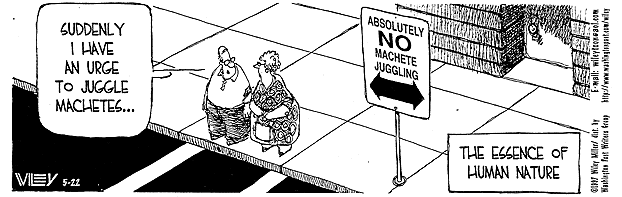
I think this cartoon perfectly captures the flag burning debate. It's human nature that as soon as someone says you can't do something, that's when everyone wants to do it. The current amendment seeks to enshrine in our Constitution the ability to outlaw a very specific form of political protest that is scarcely more common of an activity than machete juggling. But I believe this is an important symbolic issue with much larger implications, because the proposed amendment cuts back on the First Amendment's right to free speech.

How can I possibly say that, you ask? How can I possibly equate the act of burning a flag with "speech"? Well, I'm certainly in good company with this position. The Supreme Court has ruled repeatedly that nonverbal forms of communication do have some protection under the First Amendment. In the 1931 case Stromberg v. California, the Court struck down a statute that prevented people from displaying red flags in support of Communism, and in the 1969 case Tinker v. Des Moines Independent School District, the Court ruled against a school that prohibited its students from wearing an armband in protest against the Vietnam War. It’s true that lawmakers can put more restrictions on nonverbal communication than on actual speech and writing, but one thing they cannot do is outlaw an activity purely because they oppose the message that activity is intended to express.

This point is lost on Robert H. Bork. According to Bork, banning flag burning isn't outlawing an offensive idea; it's outlawing an offensive "method of expression." For example, says Bork, we are certainly entitled to "stop a political speech made from a sound truck at 2:00 AM, or prosecute a protest against sodomy laws where demonstrators engage in the practice in public" ("Waiving the Flag," Omni, Oct. 1990, p. 10).

But in both of those examples, the reason both actions are prohibited has nothing to do with the messages being expressed. If you go into a quiet neighborhood in the middle of the night and give a speech blaring from a sound truck, you'll be arrested no matter what you say. You don't even have to be saying anything; you could howl at the moon and you'd still be violating the same law.

The laws prohibiting flag burning are clearly in a different category. For example, the Texas statute which the Supreme Court struck down in 1989 actually permitted the burning of an American flag if the purpose was only to dispose of a torn or dirty flag. Obviously, the law was directed specifically at people who used flag burning to express a message of anger and contempt toward the American government.

Similarly, the proposed amendment isn't against the destruction of an American flag; it's against the "physical desecration" of the flag. What does it mean to desecrate a flag? The dictionary won't help me on this; they all define the word desecrate as strictly a religious term that you might apply to the destruction of objects found in a church or synagogue, certainly not to a secular object like an American flag. Congress, however, has defined the word as "deface, damage, or otherwise physically mistreat in a way that the actor knows will seriously offend one or more persons likely to observe or discover his action."

In other words, the amendment, like the Texas law, is not directed toward the act of flag burning. It is directed toward people who use the act to express a message of disrespect. Not that this should be surprising. There's nothing about the act of setting a flag on fire that's inherently offensive. Once you start talking about the person's intent--what's in his mind--it becomes abundantly clear that it's not what he's doing that offends, it's what he's communicating.