Showing posts with label gay rights. Show all posts

Friday, September 25, 2015

More on Trump's "authenticity"

Frank Rich is a good columnist who over the weekend engaged in a bit of silly contrarianism entitled "Donald Trump is saving our democracy." And no, he wasn't being sarcastic.
...for all the efforts to dismiss Trump as an entertainer, in truth it’s his opponents who are more likely to be playacting, reciting their politically correct and cautious lines by rote. The political market for improvisational candor is as large as it was after Vietnam and Watergate, and right now Trump pretty much has a monopoly on it.
Steve M. of Crooks and Liars wrote in response:
Candor? You can use a lot of words to characterize Trump's rhetoric in this campaign, but the one thing he's not giving us is candor -- certainly not about himself, and certainly not about the vast majority of the issues.... We know he's lying when he says he has a "foolproof plan" to beat ISIS. We know he's lying when he says he'll get Mexico to pay for a border fence. We know he's lying about his own net worth. We know he lied in the last debate about his efforts to establish casinos in Florida.
In my last post I marveled at how quick so many people are to attribute honesty to Trump, but it's especially striking coming from a liberal like Rich. It shows how deeply ingrained this way of thinking is in our culture--this habit of equating sincerity with a willingness to outrage. Commentators like Rich overlook the fact that some celebrities seem to have a pathological need to put themselves in the headlines, and that they achieve that goal by deliberately stoking outrage. It's a tactic that usually works very well, because outrage is to the media what a flame is to moths.

Why do so many people mistake this tactic for honesty? I think it comes from a sense most people have that if they were placed in front of a TV camera and were to speak aloud every thought that passed through their mind, they'd start offending people before long. I'm reminded of a bit from a Steven Wright routine:

"Do you swear to tell the whole truth and nothing but the truth, so help you God?" Yes, you're ugly. See that woman in the jury? I'd really like to sleep with her.
One thing most people figure out sometime after their 6th birthday is that an essential part of functioning in the world is avoiding saying what you really think about other people. You learn not to tell someone you find them annoying and would like them to leave; you learn not to tell someone your assessment of their sexual attractiveness or how that colors your perception of them; you learn not to say you feel immediate anxiety at the sight of a young black man walking down the street; you learn not to say transgender people make you uncomfortable.

Since many people avoid saying these sorts of things out of fear of shame, embarrassment, and ostracization, they automatically assume that the only possible explanation for why someone might break these taboos is honesty and courage. They fail to understand the topsy-turvy world celebrities live in, where it can be remarkably easy to lose one's sense of shame when doing so can be the source of a lucrative career. And it's especially seductive to think of such celebrities as bold truth-tellers if the things they're saying happen to agree with your own private beliefs.

For the record, I do think there are aspects of our culture that have gone too far in trying to suppress feelings of prejudice on such matters as race, religion, and gender. We've made bigotry into such a supreme evil that many ordinary, well-meaning people feel they have to pretend no such feelings exist inside of them when it would probably be healthier if they got it out into the open. You can call this problem "political correctness" if you like. But confronting these feelings is only a good thing if your ultimate purpose is to grow past them. Most attacks on PC, including Trump's, are based on the idea that these feelings should be expressed because they reflect sound judgment and an accurate perception of the world--and, further, that we know that's true simply because they've been suppressed. Their taboo status is their justification.

The attack on "political correctness" began in the 1980s as a critique--and a largely legitimate one, in my view--of the stifling atmosphere on many college campuses in America. But it has since devolved into a rallying cry in defense of ignorant and reactionary beliefs. When someone says "I'm not politically correct," what they usually mean is that they're refusing to rethink their beliefs in the face of other people's negative reactions to them. It's a way of celebrating a primal and simplistic outlook and treating any challenges to it as censorship.

What PC originally referred to has hardly any relevance to a figure like Trump. His views aren't being shut down, and he isn't going to starve for having expressed them. And however entertaining his candidacy may be, I can't bring myself to call his taboo-breaking courageous, not when he's getting exactly the kinds of results he craves: he's the center of attention, he's riding high in the polls, he's generating all the headlines. It should be patently obvious that he's saying what he says because he knows what buttons to push. Bashing immigrants in a Republican primary doesn't take courage; defending immigrants would. Now that would be a true example of "political incorrectness"--except nobody uses the term that way. Instead, we use it only to describe the outrageous and offensive, and to wallow in the delusion that it automatically shows authenticity and courage.

Thursday, February 16, 2012

America's liberalism and GOP propaganda

Recently Sen. Marco Rubio repeated a common right-wing talking point: "The majority of Americans are conservative." In response, Politifact noted that only a plurality, not a majority, of the public answers to the term "conservative" on polls, and that slightly more Americans identify as Democrats than as Republicans, while the largest group, independents, are evenly divided in their partisan leanings.

Rachel Maddow took Politifact to task for rating Rubio's statement Mostly True in light of these facts, but I think she misses the point. She is right to attack the Politifact article, but she attacks it for the wrong reasons. If Rubio had said, "The majority of Americans think of themselves as conservative," Politifact's rating would have been appropriate. The majority/plurality distinction is often ignored in colloquial speech, and partisan identification doesn't always match ideology or even voting tendency. What makes Rubio's statement misleading is that it implies Americans tend to fit his definition of conservatism, when the evidence strongly suggests otherwise.

He explains why he thinks Americans are conservative with his ridiculous, incendiary remark, "They believe in things like the Constitution. I know that's weird to some people." Of course few Americans of any political stripe would say they don't believe in the Constitution, but Rubio isn't basing his judgment on what they claim about themselves. President Obama may be a former professor of constitutional law, but according to conservatives like Rubio, his liberal policies prove he doesn't "believe" in his area of specialty, no matter what he says in public.

In other words, Rubio's logic implies he doesn't necessarily take people's self-descriptions at face value. I doubt he would accept, for example, the claimed conservatism of Andrew Sullivan, a staunch Obama supporter. How do we know the 40% of Americans who call themselves "conservative" are the Rubio type of conservative, as opposed to the Sullivan type, or some other type entirely?

As a matter of fact, Americans tend to prefer the policies of the Democratic Party to those of the GOP. According to polls, Americans overwhelmingly favor an increase in the the minimum wage, higher taxes on the rich, and leaving Social Security and Medicare alone. The Affordable Care Act remains unpopular, but the public option that was discarded from the bill polled well.

Public opinion on social issues such as abortion is somewhat cloudier, though the public becomes increasingly accepting of gay rights with each passing year. If there's one area of liberal thought that is continually unpopular, it is civil liberties. But Democrats know that, which is why they shy away from implementing such policies. That makes Rubio's statement about the Constitution ironic, because it seems to me that Americans as a whole don't have a great deal of respect for many of the rights outlined in the Constitution, yet that's the one area in which their views are more in line with those of Rubio's party!

Given all these facts, why do twice as many Americans identify by the term "conservative" as by the term "liberal"? Partly it's because over the past several decades conservatives have successfully turned "liberal" into a dirty word, so that even people who hold liberal policy positions are reluctant to embrace the term. (That's the main reason the American left started calling itself "progressive.") It's a total flip from the past. Traditionally the word "liberal" had positive connotations, evoking someone open-minded and forward-looking, while "conservative" was often a slightly negative word, suggesting joyless, old-fashioned squareness. (That was presumably the meaning Rush Limbaugh had in mind when he complained about a reporter who allegedly described his neckties as conservative.) The rise of a vigorous conservative movement in the 1970s at a time when liberalism was flailing helped to change these perceptions.

I'm not saying the public is, in fact, "liberal." For one thing, the American system is itself to the right of most modern, developed nations, so that even the Democratic Party would look conservative in other countries. "I have no more intention of dismantling the National Health Service than I have of dismantling Britain's defenses." Who said those words? It was that bolshevik Maggie Thatcher.

Conservatives point to polls showing that Americans tend to say they favor "limited government." But when you examine their views more closely, you find they oppose just about anything that would actually lead to a smaller government. As a 2010 Washington Post poll found, "most Americans who would like to see a more limited government also call Medicare and Social Security 'very important' programs...[and] want the federal government to remain involved in education, poverty reduction and health care regulation."

The American appetite for shrinking the government in theory but not in practice is a big part of why it's so hard to combat the country's fiscal problems. Serious cuts will almost invariably cause pain to many voters. The only category of federal spending that a majority of Americans wants to see cut is foreign aid, and most Americans are unaware it constitutes a minuscule portion of the budget. It's comforting, I suppose, to pretend the source of our problems lies an ocean away.

However Americans may describe their political philosophy in the abstract, it's obvious from any serious examination of the polls that the economic policies of the Republican Party are, for the most part, highly unpopular. So why do Republicans continue to win office? For starters, elections tend to be driven by factors other than voter agreement with policy. According to political scientists, the biggest influence on national elections is the state of the economy. The 2010 Republican sweep demonstrated this to a tee: exit polls showed that 52% of the voters wanted to see the Bush tax cuts on the rich ended, and that although 48% wanted to see Obamacare repealed, 47% wanted to see it either left alone or expanded. Thus, the electorate that brought us this "Tea Party revolution" didn't clearly agree with two of the Tea Party's key policy priorities.

Of course Republicans don't have to wait till the economy goes south to gain power. They've developed a wealth of propaganda to make their views sound more palatable to the average voter. They'll point out that Democrats want to raise taxes, and once you mention that the proposed tax hikes will only fall on the richest of Americans, a mere 1% of the country, the Republicans then accuse the Democrats of "class warfare" and hostility to "job creators." All these rhetorical devices are attempts to give voters the impression that Republicans are defending the interests of the middle class, a delusion they can only maintain by not describing their policies in plain English.

It is when Republican politicians get to entitlement talk that their propaganda descends into complete incoherence. "Keep your government hands off my Medicare" was a line seen and heard at a few Tea Party rallies, and although these were isolated incidents, they reflected a message that's pervasive in a party that calls Obamacare a "government takeover of the health-care system" while at the same time attacking it for its cuts to America's actual government health-care system.

The contradiction is sometimes laughably transparent. In 2010, a Republican Congressional candidate ran an ad blasting the Democratic incumbent for the following two sins: "Government run health care. Medicare cuts." In 2011, Michelle Bachmann warned that Obama would try to turn Medicare into Obamacare (which would actually mean privatizing it, but never mind). Then there's Romney's recent statement simultaneously assailing the president for failing to make entitlement cuts and, well, making entitlement cuts: "This week, President Obama will release a budget that won't take any meaningful steps toward solving our entitlement crisis.... The president has failed to offer a single serious idea to save Social Security and is the only president in modern history to cut Medicare benefits for seniors."

Republican messaging reached its ultimate absurdity after the passage of Paul Ryan's bill (which Romney has endorsed) that not only includes the same Medicare cuts that Romney and other Republicans have attacked Democrats for implementing, but plans eventually to eliminate Medicare in all but name--whatever Politifact may tell you to the contrary. Ryan's plan isn't popular, but that hasn't stopped Republicans from claiming to be saving Medicare while accusing Democrats of trying to destroy it.

These obfuscations are necessary because Republicans truly seek reductions in America's safety net but must contend with a public deeply opposed to that project, including one of their core constituencies, the elderly. They have no choice but to lie about their positions, because describing them truthfully would prevent the GOP from getting into power. As Jonathan Chait explained in his 2007 book The Big Con, published before the rise of Obama, the Tea Party, or the mythical death panels:
There is also a natural--and, in many ways, commendable--skepticism about one-sided accusations of dishonesty. Those who confine their accusations to one side are usually partisans best taken with a grain of salt. Lying and spinning have always been a part of politics, and it is the rare elected official who prevails by offering the voters an objective and unvarnished assessment of his plans. Moreover, since we tend to think of lying as an idiosyncratic personal trait, there's no reason to think that one side has more liars than the other any more than there's reason to think one side has more drunks or adulterers.

Yet, as will become clear, the fact remains that dishonesty has become integral to the Republican economic agenda in a way that it is not to the Democratic agenda. The reason is not that Republicans are individually less honest than Democrats. Far from it. It is simply that the GOP, and the conservative movement, have embraced an economic agenda far out of step with the majority of the voting public. Republicans simply can't win office or get their plans enacted into law, without fundamentally misleading the public. Lying has become a systematic necessity. (pp. 118-9)

Monday, December 27, 2010

Triangaylation

When it comes to same-sex marriage, President Obama is almost as transparently cynical as Mitt Romney is on most other issues. Recently he admitted that his feelings on the topic were "evolving." If so, they are evolving toward the point where he started. Back in 1996, when Obama was running for the Illinois state senate, he affirmed in a questionnaire, "I favor legalizing same-sex marriages, and would fight efforts to prohibit such marriages."

The New Republic has provided a helpful timeline chronicling his gradual move away from this position. He eventually embraced "civil unions," the term for policies that grant gay couples at least some of the benefits that married couples receive without calling the unions "marriages." Explaining his stance in 2004, he framed it as a strategic choice: "What I'm saying is that strategically, I think we can get civil unions passed.... I think that to the extent that we can get the rights, I'm less concerned about the name." But in 2008 he stated, "I believe that marriage is between a man and woman and I am not in favor of gay marriage," though he opposed the Prop 8 ban on gay marriage, calling it "unnecessary."

I find it hard to believe he was for gay marriage in '96 and later sincerely changed his mind. That might happen to someone who underwent a religious conversion and became more socially conservative. But Obama's conversion happened in the '80s, and it involved the UCC, one of the more gay-friendly denominations of American Christianity. (The UCC officially endorsed gay marriage in 2005.) The likelier explanation is that he calculated that his original position would hamper his political ambitions.

I'm not sure he was wrong. Up to now, no serious presidential contender has openly supported gay marriage, not even the supposedly progressive Howard Dean. In the 2008 election, Obama was already fighting claims that he was outside the mainstream. Open support could have easily sunk his candidacy before it got off the ground, getting him written off as another Kucinich-type flake. But now, with more and more states legalizing the practice, and with polls showing increasing support for it among the public at large, Obama probably fears being on the wrong side of history at a pivotal moment.

Other Democrats face a similar dilemma. Joe Biden recently agreed with Obama on having "evolving" views on the topic (how convenient!) and suggested gay marriage was inevitable. That's about as close to an endorsement as I ever would have imagined. But it makes sense given his history. During the 2008 vice presidential debate, he said, "We do support making sure that committed couples in a same-sex marriage are guaranteed the same constitutional benefits as it relates to their property rights, their rights of visitation, their rights to insurance, their rights of ownership as heterosexual couples do." But when the moderator Gwen Ifill asked him directly "Do you support gay marriage?" he replied, "No. [Neither] Barack Obama nor I support redefining from a civil side what constitutes marriage," but he added that people of all faiths have the right to define the relationships as they please.

Presumably, Biden's statement that he supports benefits for "couples in a same-sex marriage" was a slip of the tongue, and he meant to say simply "same-sex couples." But it's a revealing slip, highlighting the semantic nature of the issue. Throughout the last decade, the phrase "civil unions" has provided cover for politicians who don't want to appear too radical but who also don't want to seem draconian in denying couples things like visitation rights. (SNL's version of the debate has Biden saying he would "absolutely not" support same-sex marriage, but that "they should be allowed to visit one another in the hospital, and in a lot of ways that's just as good if not better.") This balancing act has been especially painful to watch in the case of Dick Cheney, whose views have apparently been affected by his having a lesbian daughter. He declined to endorse Bush's Federal Marriage Amendment in 2004, but he avoided saying anything more about his personal views than that the matter should be left to the states and that "Freedom means freedom for everybody."

All these capitulations have an unfortunate side effect: they make it easy for people to overlook the difference between pols who nominally oppose gay marriage and pols who crusade against it. Just this year, in response to the uproar over his anti-gay remarks, New York gubernatorial candidate Carl Paladino took a more conciliatory tone, pointing out that "I have the same position on [the marriage] issue as President Barrack [sic] Obama." But somehow I have trouble imagining Obama ever expressing his position the way Paladino did earlier:
If you elect me as your next governor, you can depend on me to protect and defend your family from those who seek to tear down our values and bankrupt our citizens. And yes, I will veto all legislation that mocks our sacred institution of marriage and family. I will veto any gay marriage or civil union bill that comes to my desk. Yes I'm angry. Real angry at the way our politically correct elites are mistreating our innocent children, and I want to protect them and give them a real future in America, the greatest country on God's green Earth.
The fact is, the kind of fiery talk that depicts gay marriage as a threat to our civilization comes mostly from Republicans. Democrats who claim to oppose gay marriage rarely explain their position clearly, much less engage in sky-is-falling rhetoric. Their strategy is basically one of damage control, trying to expand the practical rights of gay people while avoiding turning off too many social conservatives. But as the veil slips, it'll be interesting to watch who comes out on what side in the end.

Wednesday, November 10, 2010

The story of my political formation

The fact that I came of age during the Clinton years had an important effect on my political outlook. The first presidential election I paid any attention to was 1992, when I was 15, and although I naturally rooted for Clinton because my liberal parents did, my observations were mostly superficial. I actually don't remember the 1994 Republican takeover. It just wasn't on my radar at the time. But a year later, as I was beginning college, the government shutdown had an immediate impact on my family. My father was a federal employee, as was our next-door neighbor, a single black woman with a teenage son. It didn't help things that one of my brothers had recently passed away.

For the first time, I got a very direct glimpse of the effect that politics could have on everyday lives. It was no longer just a funny game I saw on TV, featuring colorful personalities in fancy suits. I also began to have my first informed judgment on a political figure, in this case a Congressional leader by the name of Newt Gingrich, who provided me with my first taste of what it was like to deeply loathe a politician.

I also was beginning to discover the phenomenon of Rush Limbaugh, as well as Christian Coalition figures such as Falwell, Robertson, and Reed. I personally encountered people who insisted with a straight face that the president was a rapist, a murderer, and a drug addict. These people, who included a few of my parents' friends, typically spoke of liberals as if describing a distinct species of insect. Arguing with them was usually an exercise in futility, for they had a barrage of "facts" they had picked up from talk radio, which they listened to far more often than I had time to listen to anything.

These experiences left a powerful impression on me, because I couldn't help noticing that the contemporary American right was apparently run by complete lunatics and charlatans. The maligned liberals, on the other hand, were mostly represented for me by thoughtful milquetoasts like Michael Kinsley. Maybe it wasn't fair that I got such a terrible first impression of conservatives, who I know include many reasonable individuals. I was well aware that the left had its share of clowns, such as Al Sharpton, but they didn't seem to matter a whole lot. There was a notable imbalance in the political spectrum that belied the cliche evenhandedness so many pundits found seductive.

I sometimes got the sense that even the conservative intelligentsia were simply playing the good cop to Limbaugh's bad cop, saying the same stuff in gentler language. A 1995 article I read by William F. Buckley took Clinton to task for his attacks on Limbaugh. Buckley conceded that Limbaugh "induces hatred" and that "if I were a liberal, I would hate him," but he went on to suggest that FDR and Truman did the same sort of thing to the other side. Not a word about Limbaugh's lies or conspiracy theories. This from the 20th century's greatest conservative intellectual.

I made these observations long before I gave any serious thought to budgets, taxes, health care, trade, and so on. While certain causes like environmentalism and gay rights were no-brainers to me from the start, I was initially tempted in a more rightward direction on such issues as abortion, affirmative action, and school vouchers. But the disintegration of any sane right-wing establishment was formative for me, and I would watch the problem grow ever worse as the years passed.

Everything that's happening now looks to me like the logical end result of what was happening in the '90s. A very moderate Democratic president presiding over an economic boom is clobbered by conservatives as some kind of left-wing hippie and nearly hounded from office for sexual lapses of no consequence to anyone but his own family. A Republican enters the White House under highly questionable circumstances and in the course of eight years leaves the country in two hapless wars one of which he started for no good reason, unprecedented debt, and the worst recession since the Great Depression. The disaster of the Bush years is so breathtaking I almost distrust my own judgment on the matter. Maybe I'm falling prey to the same kind of partisan hatred that characterized Clinton's adversaries. But no matter how I look at it, I can't escape the conclusion that Bush truly is one of the worst presidents in history. And it's amazing to watch the conservative establishment today attempt to make us all forget that just a few short years ago they practically worshiped the man.

When it comes to the right, the most visible difference between the 1990s and today is the rise of Fox News. Yes, it did begin in 1996, but it didn't become a force to be reckoned with until the Bush years. The first sign came with the election itself, when a reporter who just happened to be Bush's first cousin called the election for Bush, and all the other news networks--the legitimate ones, that is--followed suit. This set the tone for the Florida post-election fiasco that would follow.

Fox has grown steadily worse. Before, it was a right-leaning network that pretended to be fair and balanced. Now it's just a TV version of talk radio, a calculated, large-scale attempt to brainwash its viewers through the use of misleading propaganda, outright lies, and conspiracy-mongering, nonstop 24-hours-a-day, 7-days-a-week. It is nothing more than the right's Pravda. And it still has an astonishing influence on the mainstream networks, the ones we're supposed to believe are "liberal-biased."

So it was all set when the godfather of this mode of politics, Rush Limbaugh, said he hopes Obama fails, and not a single Republican in power had the strength to distance himself from Limbaugh, not without quickly reversing himself and groveling at Limbaugh's feet for forgiveness. This is what's truly new about the right wing: there is now no separation at all between the propagandists of right-wing media and the Republicans holding public office.

And somehow, the things said against Obama and other Democrats are worse than during the Clinton years. Back then, the attacks were merely nasty. Now, it is absolutely no exaggeration to say that Republican politicians and commentators are stoking insurrection. The tone of conservative hatred today isn't just hysterical, but contains not-very-subtle appeals to violence: talks of Second Amendment remedies, drawing crosshairs on Congressional maps with the slogan "Don't retreat--reload," explicitly defending violent overthrow of the government. The rhetoric is increasingly apocalyptic, and the very name of the opposition movement--"Tea Party"--deliberately alludes to the events leading up to the American Revolution. What's scariest about all this is that the Clinton years gave us Timothy McVeigh; who knows what's coming up now. And something will, make no mistake, because the tea-partiers will invariably be disappointed when the officials they have elected fail to stop Obama's agenda. And they don't strike me as the sorts of people to take disappointment by packing their bags and walking home.

That's why there's a lot more to the current political situation than rooting for teams. I don't mean to suggest that the past was one long Golden Age–I know my parents' generation alone went through Vietnam and Watergate–but I feel in my bones that there's something uniquely disturbing about what's happening now, even under the first president in my life I've had any enthusiasm for.
This post is based on a comment I wrote on Emily Hauser's blog last week. She suggested that I post it to my blog. I expanded on a few sections and edited the wording here and there, but it's more or less the same.
Cross-posted to Daily Kos.

Friday, June 13, 2008

The pursuit of weird happiness

It seems like in every discussion about gay rights, opponents raise the specter of sex with youngsters, siblings, sheep, goats, dogs, corpses, and just about every other forbidden--and sometimes not-so-forbidden--union. As Justice Scalia wrote in his dissenting opinion to Lawrence v. Texas, "State laws against bigamy, same-sex marriage, adult incest, prostitution, masturbation, adultery, fornication, bestiality, and obscenity are likewise...called into question by today's decision." Imagine that: if we're soft on homosexuality, next thing you know they'll be allowing masturbation.

Commentators usually call this type of reasoning a slippery slope, but it is more of a reductio ad absurdum. The difference is subtle but important. With a slippery slope, you're opposing a policy on the grounds that it will lead to worse policies--regardless of logical connection. With reductio ad absurdum, you're attempting to expose the flaw in an argument by showing that its logic leads in unacceptable directions. The classic example is the cliché response to peer pressure: "If your friends jumped off a cliff, would you follow them?"

People often use reductio ad absurdum to hide the weaknesses of their own arguments. It's pretty easy, with the help of a little self-delusion, to shut your mind to nuanced distinctions. Then all you have to do is tell your opponent, "If you hold X, you might as well hold Y." While he's busy explaining why he doesn't hold Y, he doesn't notice that you've shifted the discussion away from X.

Over at DovBear's blog, I recently had a debate with a fellow who calls himself Lawyer-Wearing-Yarmulka. He reiterated an argument he made two years ago in which he suggested that the philosophy of consent underlying gay rights could be used to justify sex between men and cows. His point was that we never demand consent from cows for anything else we do to them. If we can turn them into burgers without their consent, why shouldn't we be allowed to have sex with them?

LWY fails to understand that consent has a particular significance with regard to sex acts, which doesn't apply to other types of acts. By their nature, unwanted sexual experiences are highly traumatic. The notion that there's something inconsistent about opposing cruelty to animals while condoning slaughter of animals is an argument I would expect from a PETA member, not a Bible-believing Jew.

I'm astounded by LWY's suggestion that the law against raping a cow is entirely for the human's benefit, not the cow's. (It brings to mind Lord Macaulay's statement, "The Puritan hated bearbaiting, not because it gave pain to the bear, but because it gave pleasure to the spectators.") This certainly is not the common view in our legal system, where bestiality is typically classed under "animal abuse." While that may differ in some ways from the traditional perspective, that just goes to show that our society has over time shown an increasing concern for the treatment of animals, even if it is still far from perfect.

Notice how far this discussion has drifted from its original topic. In that whole time, LWY didn't offer even one justification for his position on gay rights. All he did was make an egregiously poor analogy, but because it concerned treatment of animals, an area of public policy that is controversial and by no means perfectly consistent, he was able to keep the discussion pointed away from himself.

I've repeatedly encountered this sort of evasive attitude from critics of gay rights. Instead of explaining their own point of view, they spend an inordinate amount of time trying to catch defenders in an inconsistency regarding other sexual deviances. What's especially surprising is that they tend to jump on the least relevant examples, where there is clearly a victim.

Ironically, LWY dismissed the importance of incest, a much better example to create the sort of reductio ad absurdum he was trying to establish. Let's say an adult brother and sister become lovers. Let's say they're not going to have kids: they use birth control, or one of them is infertile, or the woman is past menopause. Their affair would still be illegal in most places. Yet it is a purely victimless act between consenting adults, and so, by the standard argument in support of gay rights, it should be allowed.

What would happen if we did allow it? We might then have to make provisions to ensure that incestuous lovers never have children. Further, we would have to deal with the competing argument that they have a right to have kids, even ones who will likely have genetic defects. And I haven't even mentioned the marriage issue. This is all a big can of worms to open up in the name of consistency (according to Wikipedia, this form of incest is extremely rare), but it is something our society might have to face, if we are to remain committed to the principle that people have the right to pursue their own happiness as long as it doesn't hurt others.

Some gay rights activists, of course, would object to this example on the grounds that incest is "sick" and "disgusting." That's what critics of gay rights want the defenders to concede, that there are certain acts that just fall outside the bounds of civilized behavior, even if they seem to harm no one. But it's unlikely that this example will persuade anyone to abandon a belief in gay rights. This reductio ad absurdum at best reveals an inconsistency in the views of some advocates, but it doesn't come close to dismantling the philosophy behind gay rights.

Monday, February 18, 2008

The Macho Right

Cross-posted at DovBear's blog

In his book The Conservative Soul, bleeding-heart conservative Andrew Sullivan writes, "Even the most passionate of the [Bush] Administration's defenders cannot argue that [waterboarding] is not 'cruel, degrading and inhuman' treatment.... The notion that 'waterboarding' is not torture under the plain meaning of the word as well as its legal meaning is preposterous" (p. 169).

I contrast that with Rudy Giuliani's statement about being unsure whether waterboarding is torture. How do you possibly resolve a disagreement like this? Unless you go to the extreme of testing waterboarding on yourself, as Daniel Levin did, it's basically one person's opinion against another's. Frankly, I doubt the former New York mayor, who built his reputation on dogged machismo, is likely to be swayed by, let's face it, a prissy gay Englishman.

Sullivan attributes the Bush view of torture to "the fundamentalist psyche," which holds that "what matters is his intent, not the empirical analysis" (p. 170). This forms part of Sullivan's larger theory that the world is divided into two types of people, fundamentalists and...well, everyone else, I guess. Into the first category he includes various Evangelicals, Catholics, Mormons, Zionists, Islamists, Nazis, and Communists. He characterizes fundamentalism as hostile toward reason, and among the unreasonable qualities he lists are, oh, a black-and-white "us vs. them" mentality. Hmmmmmmm.

The chip in his theory is that Giuliani is no fundamentalist, by the plain meaning of the word as well as its legal meaning. I therefore propose an alternative theory that is equally simplistic, but at least it knows it is. The assault on reason here is coming not from the Religious Right, but from the Macho Right.

Contrary to popular belief, members of the Religious Right are quite capable of reasoned thought, at least when it suits their purposes. Reason is absolutely irrelevant to members of the Macho Right, who are driven not by reason, but by testosterone.

Even if you've never heard the term, you surely are familiar with the right-wingers who seem to build their whole outlook on machismo. "We gotta be tough on crime. We gotta bomb the commies/Muslims/insert-your-own-enemy back to the Stone Age. We gotta stop the liberals who want to take guns away from the real men who own them."

It's no wonder all those tough-guy movie stars, at least the ones who aren't into martial arts, vote Republican: Schwarzenegger, Stallone, Eastwood, and Willis.

Schwarzenegger, who has never clearly explained why he's a Republican, is a perfect example. You remember when he characterized his Democratic opponents as "economic girlie men" (never mind that he supports universal health care). Then some gay rights organizations, eager to play Charlie Brown to Lucy's football, complained that his remarks were insulting to homosexuals. Uh-huh.

To qualify for the Macho Right, you don't have to be religious. You don't even have to be conservative in a traditional sense. You certainly don't have to be genuinely tough. As we have seen, right-wingers are more than willing to paint true American heroes like John McCain and John Kerry as spineless sissies.

Some notable examples of Macho Rightists in the media are Michael Savage, Ann Coulter, and Bill O'Reilly. You remember Savage. He's the guy who got kicked off of MSNBC because he referred to a caller as a "sodomite" and told him to "get AIDS and die."

Savage, an irreligious Jew, can hardly be accused of Bible-thumping. Macho Rightists aren't fueled by the Bible, which may even provide them with some distractions, such as the admonition to love the sinner. They're the types of people who are given to saying things like, "Get your hands off me, you faggot!!!!"

When Hillary Clinton called Ann Coulter "heartless," referencing her book Godless, Coulter replied, "Oh, lighten up, girl." Apparently realizing the flaw in Hillary's approach, Joe Maguire titled his anti-Coulter book Brainless. That of course has more bite, but it still misses the point. Macho Rightists don't care about brains. They care about cojones.

After all, who else is the emblem of the Macho Right today than President George W. Bush, that tough, macho cowboy who's just like...well, certainly not like the folks from Brokeback Mountain. Those are just sissies who herd cows.

I was once listening to a Macho Right acquaintance of mine rail against bicycle helmets. He wasn't talking about government regulation. He simply hated seeing kids wear them, claiming that today's parents are raising a generation of wimps who can't handle the world.

I had a nasty bicycle spill when I was fifteen. I was wearing no helmet or kneepads. Luckily, I didn't land on my head, but what if I had? I might not be here now to talk about the incident.

The experience gives me a slight advantage when arguing with Macho Rightists. I wouldn't stand a chance against them if all I had were statistics and reasoned arguments. When a Macho Rightist talks, there is absolutely nothing you say, no reasoned argument, that can possibly sway them. On the contrary, the slightest appeal to reason makes you sound like the wuss they know you are. The only way to combat their rhetoric is through more macho rhetoric.

Bill O'Reilly has actually used Macho Right logic to argue against the death penalty. He says that we should give the convicts life in prison so that they can suffer more.

It's hard to say how many Macho Rightists there are, but you know them when you hear them. If you ask any of them whether they belong to the Macho Right, they aren't likely to admit it. The term probably reminds them too much of the Village People.

Friday, November 17, 2006

In defense of Orthodox liberalism

Cross-posted at DovBear's blog

R. Harry Maryles writes in this this post, "It is a fact that the conservative principles are generally more in line with Orthodox Judaism than are liberal principles. Although that isn’t 100% the case, I think it is true most of the time."

I care to disagree. But I should note that if Harry had begun the sentence with "It is my opinion..." rather than "It is a fact..." I would not have objected. He is entitled to his views, but they are debatable. Still, I have heard similar sentiments from many other frum people, and it is a topic worth discussing.

A large part of what has inspired the rightward shift among frum voters in recent decades parallels the influences on evangelical Christians: the "traditional values" of which the Republican Party has appointed itself the sole bearer. While those values have nothing to do with the conservative philosophy of unfettered capitalism, Republican politicians created a marriage between these two meanings of conservatism. It is an unhappy marriage. Religious conservatives were duped by Reagan, and many of them have recently woken up to the fact that they've also been duped by Bush.

I've always been amazed at the mental acrobatics of those who argue that Judaism fits the philosophy behind economic conservatism. Their rationale depends partly on the standard but inaccurate translation of tzedakah as "charity." In modern American society, charity is simply a praiseworthy act. In ancient Israel, however, tzedakah was the law of the land. The conservative tenet that we must encourage volunteerism in place of government aid runs contrary to much traditional Jewish thought.

When I raised this point on Harry's blog, Bari noted differences between the ancient Jewish system and modern liberal programs. For example, in halacha a person gets to decide which poor people to give to. When I pointed out that one of the highest forms of tzedakah is giving to someone unknown, Bari replied, "And it's theft if you take it from me to give it to someone else who I don't know. When the govt. does it, maybe it's not theft, but it's not right Al Pi Din Torah."

Bari is walking on thin ice here. Either you think that it's okay to have the government enforce donations to the poor, or you don't. If you don't, but you make an exception for Judaism's specific mandates, and you declare anything else to be "theft" or something close to it, then you're not being philosophically consistent.

Having said that, I should point out that there is a good deal more to politics than philosophy. I don't fault any frum person for taking conservative positions on particular issues. There is room in Yiddishkeit for a variety of political perspectives, once we move past ideology and get into specifics. The problem is that many of us have a hard time stepping outside our own political perspectives and acknowledging that other viewpoints have legitimacy. When we feel strongly about an issue, it is easy to fall into the trap of ascribing simplistic motives to the other side and of not recognizing how complex the issue really is. I'm sure I have been guilty of this before, but I definitely see it in frum conservatives. It is implicit in Harry's statement that "conservative principles are generally more in line with Orthodox Judaism," which almost makes it sound like we can just do a head-count of political positions and declare this one as being more in line with Torah values, that one as being less, and so on.

So let me be clear: On almost any major issue in American politics today, a case could be made for both sides without sacrificing one's commitment to Torah principles. There are possible exceptions, like gay marriage or opposition to stem-cell research. But most issues fall into one of the following three categories:

1) Issues where the Torah's view is irrelevant. One example is gun control. Occasionally I have heard Orthodox rabbis on both sides of this debate attempt to "spin" their favored position as more Torah-based, but their arguments are unconvincing, for the disagreement (properly understood) does not stem from any fundamental difference of values and has no real bearing on halacha. So too with the vast majority of American political issues.

2) Issues where the Torah's view is relevant, but where there is still rabbinic support for both sides. An excellent example is the death penalty. Harry's mentor R. Ahron Soloveichik not only opposed the death penalty but believed that every Jew should.

3) Issues where Jewish law may seem more in line with one side, but where pragmatic considerations might tilt it the other way. This category includes many "social issues" that religious conservatives focus upon, such as abortion.

In sum, I welcome debate on the specifics of any issue. At the same time, I believe that there is much in common between traditional Judaism and many core liberal ideals. It's not absolute, but then neither is the pact that R. Lapin and co. have attempted to make with the Christian Right. And frankly I think the latter poses a greater danger to our freedom as Jews than the fuzzy liberal tolerance that so many frum people claim to despise. Christian conservatives may play nicey-nice to us, but in the long run they're being disingenuous, as becomes clear in the slip-ups by the less shrewd among them (e.g. Katherine Harris). You have to be extremely deluded to believe that the Christian Right views us as an equal partner. No doubt we should stand up for what we believe in, whether economic or social, but we must also be careful not to be so blinded by ideology that we enter into an unhealthy relationship.

Tuesday, June 27, 2006

The issue that will not die


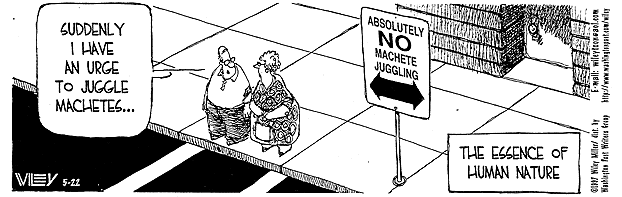
I think this cartoon perfectly captures the flag burning debate. It's human nature that as soon as someone says you can't do something, that's when everyone wants to do it. The current amendment seeks to enshrine in our Constitution the ability to outlaw a very specific form of political protest that is scarcely more common of an activity than machete juggling. But I believe this is an important symbolic issue with much larger implications, because the proposed amendment cuts back on the First Amendment's right to free speech.

How can I possibly say that, you ask? How can I possibly equate the act of burning a flag with "speech"? Well, I'm certainly in good company with this position. The Supreme Court has ruled repeatedly that nonverbal forms of communication do have some protection under the First Amendment. In the 1931 case Stromberg v. California, the Court struck down a statute that prevented people from displaying red flags in support of Communism, and in the 1969 case Tinker v. Des Moines Independent School District, the Court ruled against a school that prohibited its students from wearing an armband in protest against the Vietnam War. It’s true that lawmakers can put more restrictions on nonverbal communication than on actual speech and writing, but one thing they cannot do is outlaw an activity purely because they oppose the message that activity is intended to express.

This point is lost on Robert H. Bork. According to Bork, banning flag burning isn't outlawing an offensive idea; it's outlawing an offensive "method of expression." For example, says Bork, we are certainly entitled to "stop a political speech made from a sound truck at 2:00 AM, or prosecute a protest against sodomy laws where demonstrators engage in the practice in public" ("Waiving the Flag," Omni, Oct. 1990, p. 10).

But in both of those examples, the reason both actions are prohibited has nothing to do with the messages being expressed. If you go into a quiet neighborhood in the middle of the night and give a speech blaring from a sound truck, you'll be arrested no matter what you say. You don't even have to be saying anything; you could howl at the moon and you'd still be violating the same law.

The laws prohibiting flag burning are clearly in a different category. For example, the Texas statute which the Supreme Court struck down in 1989 actually permitted the burning of an American flag if the purpose was only to dispose of a torn or dirty flag. Obviously, the law was directed specifically at people who used flag burning to express a message of anger and contempt toward the American government.

Similarly, the proposed amendment isn't against the destruction of an American flag; it's against the "physical desecration" of the flag. What does it mean to desecrate a flag? The dictionary won't help me on this; they all define the word desecrate as strictly a religious term that you might apply to the destruction of objects found in a church or synagogue, certainly not to a secular object like an American flag. Congress, however, has defined the word as "deface, damage, or otherwise physically mistreat in a way that the actor knows will seriously offend one or more persons likely to observe or discover his action."

In other words, the amendment, like the Texas law, is not directed toward the act of flag burning. It is directed toward people who use the act to express a message of disrespect. Not that this should be surprising. There's nothing about the act of setting a flag on fire that's inherently offensive. Once you start talking about the person's intent--what's in his mind--it becomes abundantly clear that it's not what he's doing that offends, it's what he's communicating.